Cummings
Guides Home..|..Contact
This Site
.
.
Study Guide Prepared by
Michael J. Cummings
.
Type
of Work
......."A
Valediction: Forbidding Mourning" is a lyric
poem. Some scholars further classify it as a metaphysical poem;
Donne himself did not use that term. Among the characteristics of a metaphysical
poem are the following:
-
Startling comparisons or contrasts
of a metaphysical (spiritual, transcendant, abstract) quality to a concrete
(physical, tangible, sensible) object. In "A Valediction: Forbidding Mourning,"
Donne compares the love he shares with his wife to a compass. (See Stanza
7 of the poem).
-
Mockery of idealized, sentimental
romantic poetry, as in Stanza 2 of the poem.
-
Gross
exaggeration (hyperbole).
-
Presentation
of a logical argument. Donne argues that he and his wife will remain together
spiritually even though they are apart physically.
-
Expression
of personal, private feelings, such as those Donne expresses in "A
Valediction: Forbidding Mourning."
Publication
Information
......."A
Valediction: Forbidding Mourning" was first published in 1633, two years
after Donne died, in a poetry collection entitled Songs and Sonnets.
Summary
With an Explanation of the Title
.......In
1611, John Donne wrote "A Valediction: Forbidding Mourning" to his wife,
Anne More Donne, to comfort her while he sojourned in France on government
business and she remained home in Mitcham, England, about seven miles from
London. The title says, in essence, "When we part, we must not mourn."
Valediction
comes from the Latin verb valedicere, meaning to bid farewell.
(Another
English word derived from the same Latin verb is valedictorian,
referring to a student scholar who delivers a farewell address at a graduation
ceremony.) The poem then explains that a maudlin show of emotion would
cheapen their love, reduce it to the level of the ordinary and mundane.
Their love, after all, is transcendant, heavenly. Other husbands and wives
who know only physical, earthly love, weep and sob when they separate for
a time, for they dread the loss of physical closeness. But because Donne
and his wife have a spiritual as well as physical dimension to their love,
they will never really be apart, he says. Their souls will remain united–even
though their bodies are separated–until he returns to England.
John
and Anne More Donne
.......John
Donne (1572-1631) was one of England's greatest and most innovative poets.
He worked for a time as secretary to Sir Thomas Edgerton, the Keeper of
the Great Seal of England. When he fell in love with Anne More (1584-1617),
the niece of Edgerton's second wife, he knew Edgerton and Ann's father–Sir
George More, Chancellor of the Garter–would disapprove of their marriage.
Nevertheless, he married her anyway, in 1601, the year she turned 17. As
a result, he lost his job and was jailed for a brief time. Life was hard
for them over the next decade, but in 1611 Sir Robert Drury befriended
him and took Donne on a diplomatic mission with him to France and other
countries. Donne's separation from his wife at this time provided him the
occasion for writing "A Valediction: Forbidding Mourning."
.......Anne
bore him twelve children–five of whom died very young or at birth–before
she died in 1617.
Figures
of Speech
Metaphor
.......Donne
relies primarily on extended metaphors
to convey his message. First, he compares his separation from his wife
to the separation of a man's soul from his body when he dies (first stanza).
The body represents physical love; the soul represents spiritual or intellectual
love. While Donne and his wife are apart, they cannot express physical
love; thus, they are like the body of the dead man. However, Donne says,
they remain united spiritually and intellectually because their souls are
one. So, Donne continues, he and his wife should let their physical bond
"melt" when they part (line 5).
.......He
follows that metaphor with others, saying they should not cry sentimental
"tear-floods" or indulge in "sigh-tempests" (line 6) when they say farewell.
Such base sentimentality would cheapen their relationship. He also compares
himself and his wife to celestial spheres, such as the sun and others stars,
for their love is so profound that it exists in a higher plane than the
love of husbands and wives whose relationship centers solely on physical
pleasures which, to be enjoyed, require that the man and woman always remain
together, physically.
.......Finally,
Donne compares his relationship with his wife to that of the two legs of
a drawing compass. Although the legs are separate components of the compass,
they are both part of the same object. The legs operate in unison. If the
outer leg traces a circle, the inner leg–though its point is fixed at the
center–must pivot in the direction of the outer leg. Thus, Donne says,
though he and his wife are separated, like the legs of the compass, they
remain united because they are part of the same soul.
Paradox
.......In
the sixth stanza, Donne begins a paradox, noting that his and his wife's
souls are one though they be two; therefore, their souls will always be
together even though they are apart.
Simile
.......Stanza
6 also presents a simile, comparing the expansion of their souls to the
expansion of beaten gold.
Alliteration
.......Donne
also uses alliteration extensively. Following are examples:
Whilst
some
of their sad
friends do say
(line 3)
Dull
sublunary
lovers'
love
(line 13)
(Whose
soul
is sense)
cannot admit (line 14)
That our selves know
not
what it is, (line 18)
Our two souls therefore,
which
are one (line 21)
Thy soul, the fixed
foot,
makes no show
Thy firmness
makes
my
circle just, / And makes
me
end where I begun (lines 35-36)
.
.
Theme
.......Real,
complete love unites not only the bodies of a husband and wife but also
their souls. Such spiritual love is transcendent, metaphysical, keeping
the lovers together intellectually and spiritually even though the circumstances
of everyday life may separate their bodies.
Rhyme
Scheme and Meter
End rhyme occurs in the first
and third lines of each stanza and in the second and fourth lines. The
meter is iambic tetrameter, with eight
syllables (four feet) per line. Each foot, or pair of syllables, consists
of an unstressed syllable followed by a stressed syllable. The first two
lines of the second stanza demonstrate this metric pattern:
....1......
. ..2...........
....3.................4
So
LET..|..us
MELT..|..and
MAKE..|..no
NOISE
....1............
..2........... ....3........
.........4
No
TEAR-..|..floods
NOR..|..sigh-TEMP..|..ests
MOVE
A Valediction: Forbidding
Mourning
By John Donne
Text and Stanza Summaries
1
As virtuous men pass mildly
away,
And whisper
to their souls to go,
Whilst some of their sad
friends do say
The breath
goes now, and some say, No:
Summary, Stanza 1
Good men die peacefully because
they lived a life that pleased God. They accept death without complaining,
saying it is time for their souls to move on to eternity. Meanwhile, some
of their sad friends at the bedside acknowledge death as imminent, and
some say, no, he may live awhile longer.
2
So
let us melt, and make no noise,
No tear-floods, nor sigh-tempests move,
'Twere
profanation of our joys
To tell the laity our love.
Summary, Stanza 2
Well,
Anne, because I will be in France and other countries for a time while
you remain home in England, we must accept our separation in the same way
that virtuous dying men quietly accept the separation of their souls from
their bodies. While the physical bond that unites us melts, we must not
cry storms of tears. To do so would be to debase our love, making it depend
entirely on flesh, as does the love of so many ordinary people (laity)
for whom love does not extend beyond physical attraction.
3
Moving
of th' earth brings harms and fears,
Men reckon what it did and meant,
But
trepidation of the spheres,
Though greater far, is innocent.
Summary, Stanza 3
Earthquakes
(moving of th' earth) frighten people, who wonder at the cause and
the meaning of them. However, the movements of the sun and other heavenly
bodies (trepidation of the spheres) cause no fear, for such movements
are natural and harmless. They bring about the changes of the seasons.
4
Dull
sublunary lovers' love
(Whose soul is sense) cannot admit
Absence,
because it doth remove
Those things which elemented it.
Summary, Stanza 4
You and I are like the heavenly
bodies; our movements–our temporary separations–cause no excitement. On
the other hand, those who unite themselves solely through the senses and
not also through the soul are not like the heavenly bodies. They inhabit
regions that are sublunary (below the moon)
and cannot endure movements that separate.
5
But we by a love so much
refined
That
our selves know not what it is,
Inter-assurèd of
the mind,
Care
less, eyes, lips, and hands to miss.
Summary, Stanza 5
By contrast, our love is
so refined, so otherworldly, that it can still survive without the closeness
of eyes, lips, and hands.
6
Our two souls therefore,
which are one,
Though
I must go, endure not yet
A breach, but an expansion,
Like
gold to aery thinness beat.
Summary, Stanza 6
The point is this: Even though
our bodies become separated and must live apart for a time in different
parts of the world, our souls remain united. In fact, the spiritual bond
that unites us actually expands; it is like gold which, when beaten with
a hammer, widens and lengthens.
7
 If
they be two, they are two so If
they be two, they are two so
As stiff
twin compasses are two;
Thy soul, the fixed foot,
makes no show
To move,
but doth, if th' other do.
Summary, Stanza 7
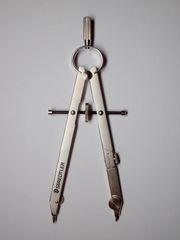
Anne, you and I are like
the pointed legs of a compass (pictured at right in a photograph provided
courtesy of Wikipedia), used to draw circles and arcs.
8
And though it in the centre
sit,
Yet when
the other far doth roam,
It leans and hearkens after
it,
And grows
erect, as that comes home.
Summary, Stanza 9
One pointed leg, yours, remains
fixed at the center. But when the other pointed leg, mine, moves in a circle
or an arc, your leg also turns even though the point of it remains fixed
at the center of my circle. Your position there helps me complete my circle
so that I end up where I began.
9
Such wilt thou be to me,
who must
Like
th' other foot, obliquely run;
Thy firmness makes my circle
just,
And makes
me end where I begun.
Summary, Stanza 10
Donne continues the metaphor
begun in Stanza 7, in which he compares himself and his wife to the legs
of a compass. Because the leg of Anne's compass remains firmly set in the
center of the circle, she enables the leg of her husband's compass to trace
a circle and return to the place from which he embarked. |
.
 ..
..
|
